Typing Books vs Monkeytype: Why Type Real Prose?

By The Typersguild Team
Writes the Typersguild blog. Comparisons are checked against the product and the sources linked in each post.
@typersguildMonkeytype is one of the best typing tests on the internet. It is fast, minimal, endlessly customizable, open source, and free. If you want to know how fast you type right now, it is hard to beat.
But measuring your speed and building it are two different jobs. This post explains why typing real prose, meaning whole chapters of real books, is such an effective way to do the second job. It also covers how to use Monkeytype and book typing together instead of picking a side.
What Monkeytype does brilliantly
Monkeytype describes itself as "a minimalistic and customizable typing test", and it delivers. You can run timed tests (15, 30, 60 or 120 seconds by default), word-count tests (10 to 100 words), quotes, a free-typing zen mode, or custom text. You can toggle punctuation and numbers, switch between many languages, pick a theme, and compete on daily and all-time leaderboards. After each test you get WPM, raw speed, accuracy and consistency.
It is also open source under the GPL-3.0 license, with an optional-ads model and a big community. For benchmarking, it is excellent.
Measuring speed is not the same as building it
A timed test is a sprint. It tells you your top speed over 30 or 60 seconds on a fairly predictable word list, and it gives you a number to chase. That is useful. But the skills that make you fast at real writing (emails, essays, code comments, notes) build up over hours of typing, not seconds.
Research on how people actually get good at typing points the same way. Pinet et al. (2022) tested 1,301 university students in a preregistered study. Frequent everyday keyboard use was associated with higher typing skill, while deliberate practice was not a significant predictor. Volume of real typing is what moves the needle.
For context on what "fast" means: the large Aalto University study of 136 million keystrokes from about 168,000 volunteers (Dhakal et al., 2018) found an average speed of about 52 WPM.
So the question becomes: what kind of practice gives you the most hours of real typing that you actually enjoy?
Why real prose trains different skills than random words
Punctuation and capitals in their natural habitat
Monkeytype's default English test uses common lowercase words. You can turn punctuation on, but it is added to a word list rather than arising from sentences. Books are full of commas, semicolons, apostrophes, quotation marks, em dashes and capital letters, in the places real writing puts them. When you type Pride and Prejudice, you practice a comma before a quotation mark hundreds of times without thinking about it.
Real letter patterns, including the awkward ones
Common-word lists over-represent short, easy words. Real prose contains the full spread of English: long words, rare letter pairs, names, numbers and dialect. That is where most people's weak spots hide. Typersguild runs n-gram analysis on everything you type, so you can see which letter pairs cost you the most time or the most errors, and then watch them improve chapter by chapter.
Endurance and focus
Most of us can hold peak speed for 30 seconds. Holding steady accuracy for 20 minutes is a different skill, and it is the one real work requires. A chapter is a natural unit: long enough to train stamina, short enough to finish in one sitting.
A reason to come back tomorrow
This is the underrated one. A word list never ends on a cliffhanger. A good book does. If the practice you enjoy is the practice you repeat, a story you care about is a powerful habit loop. And when you reach the last page of Dracula, you have not just practiced. You have actually read Dracula.
Monkeytype vs typing books: side by side
| Monkeytype | Typing books on Typersguild | |
|---|---|---|
| Best for | Measuring speed, warm-ups, competing | Building speed through volume on real prose |
| Typical session | 15–120 second tests | A chapter, or a Wikipedia article |
| Text | Common words by default; quotes and custom text | More than 380 public books, plus Wikipedia |
| Punctuation | Optional | Always on, as the author wrote it |
| Stats | WPM, raw speed, accuracy, consistency | WPM, accuracy, weak letter pairs, daily activity |
| Price | Free and open source | Free. Premium is $4.99 a month |
Monkeytype details from its public README and source code, checked October 2026.
"Can't I just paste a book into Monkeytype's custom mode?"
You can, and it is a perfectly good trick for a one-off passage. The friction shows up when you try to do it for a whole book. You have to find a clean text, split it into chunks, remember where you stopped, and track progress across hundreds of sessions yourself.
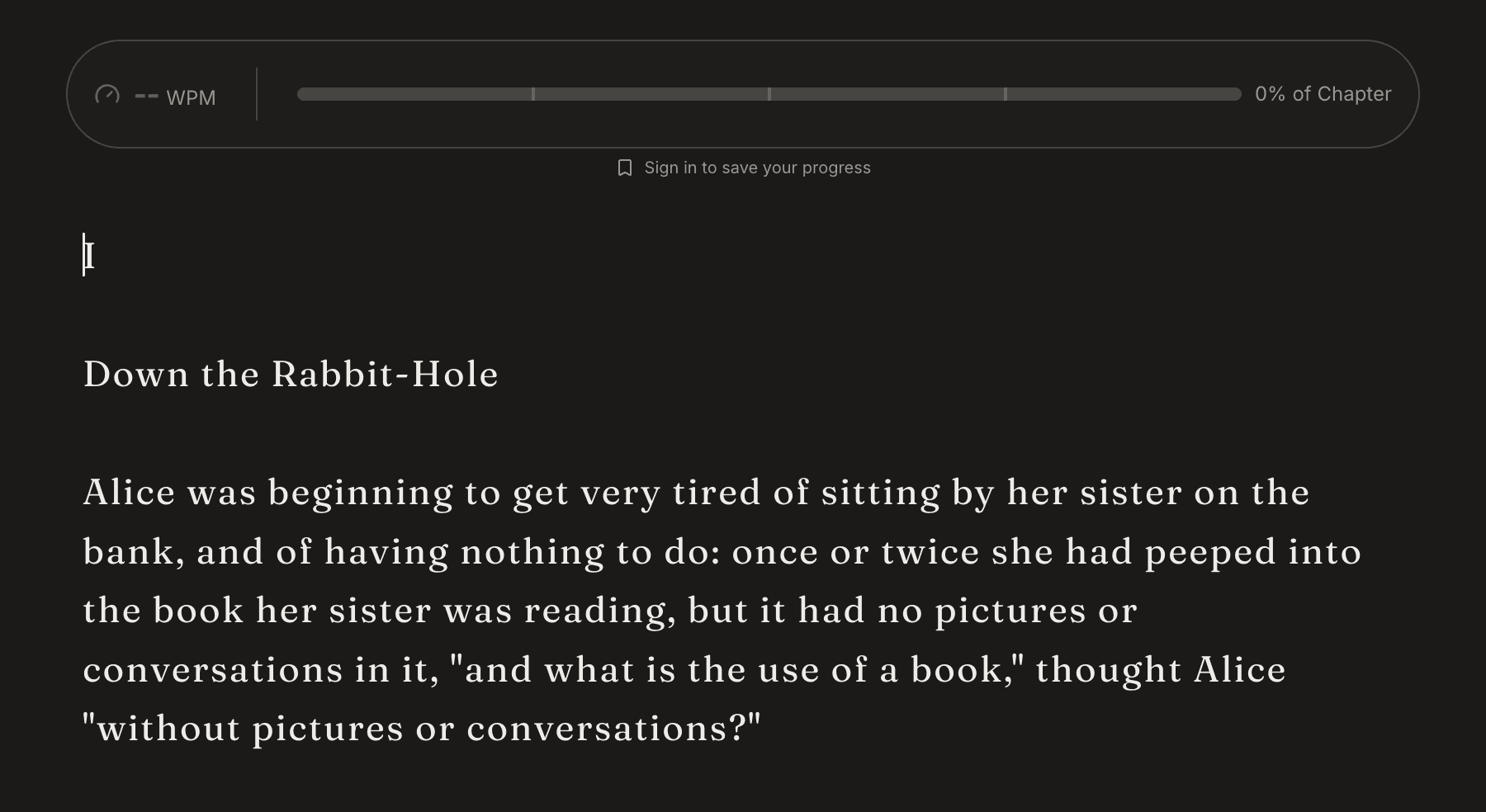
A book-typing app does that bookkeeping for you. On Typersguild you pick a title from the library, it remembers your place, and your stats build up across the whole book. Your weak letter pairs are tracked over everything you have typed, not just the last test.
How to use both: a simple weekly routine
You do not have to choose. Here is a routine that plays to each tool's strengths:
Benchmark once a week on Monkeytype. Run the same test every time, for example a 60-second English test with punctuation on, and write the number down. Same settings, same time of day.
Practice daily on a book. Type one chapter a day on Typersguild, or a Wikipedia article on a busy day. Aim for accuracy first. Speed follows.
Check your weak letter pairs. Every few days, look at your n-gram stats and notice which pairs keep showing up. Slow down on them deliberately in your next chapter.
Warm up, then go long. If you like, do one quick Monkeytype test as a warm-up before your book session. It is a fun way to get your hands moving.
Pick books you actually want to read. Motivation is the whole game. Browse the popular books list, or start with Alice in Wonderland if you want something short.
Over a few weeks, your weekly Monkeytype number becomes the scoreboard and your book sessions become the training.
When a typing test is the right tool
To be clear, a timed test is the right choice when:
you need a quick, comparable measurement of your speed,
you are preparing for a timed typing assessment,
you want a two-minute warm-up, or
you enjoy competing on a leaderboard.
For all of those, Monkeytype is a great pick. Book typing is for the rest of your practice time.
Getting started with book typing
Since January 2025, more than 3,900 people have finished more than 1.4 million paragraphs on Typersguild.
Open the Typersguild library and pick a book. Dracula, The Jungle Book and Pride and Prejudice are popular starting points.
Start typing the first chapter. No account is needed to explore. Sign in with Google, Discord or X to save progress.
Choose a theme and, if you like the sound of a mechanical keyboard, turn on typing sounds. You can audition switches with the mechanical key sounds tool.
Come back tomorrow for the next chapter.
Comparing book-typing sites? Read our Typersguild vs TypeLit comparison. Have questions about plans or uploads? See the FAQ.
FAQ
Is typing books better than Monkeytype?
They do different jobs. Monkeytype is excellent for measuring your current speed in short tests. Typing whole books gives you long sessions on real prose, with punctuation, capitals and natural letter patterns, which is the kind of volume research links to typing skill. Many people use both.
Does typing real text improve typing speed?
Typing more improves typing speed, and real text makes it easier to type more. A 2022 study of 1,301 students by Pinet et al. found that frequent everyday keyboard use was associated with higher skill, while deliberate drill practice was not a significant predictor.
Can I type a book in Monkeytype's custom mode?
Yes, you can paste text into custom mode for a single passage. For a whole book, a dedicated app like Typersguild saves your place, tracks progress chapter by chapter, and analyzes your weak letter pairs across everything you type.
What is a good typing speed?
A 2018 Aalto University study of about 168,000 volunteers measured an average of about 52 WPM. Rather than chasing a single number, track your own speed on the same test each week and aim for steady accuracy.
Is Typersguild free?
Yes. The free plan includes the public books library, Wikipedia articles, live WPM and accuracy, all themes and fonts, and typing sounds. Premium ($4.99/month) adds private EPUB uploads, cloud sync and deeper analytics.
Start your first chapter
Keep Monkeytype for the scoreboard. Use books for the training. Pick a book and start typing →